
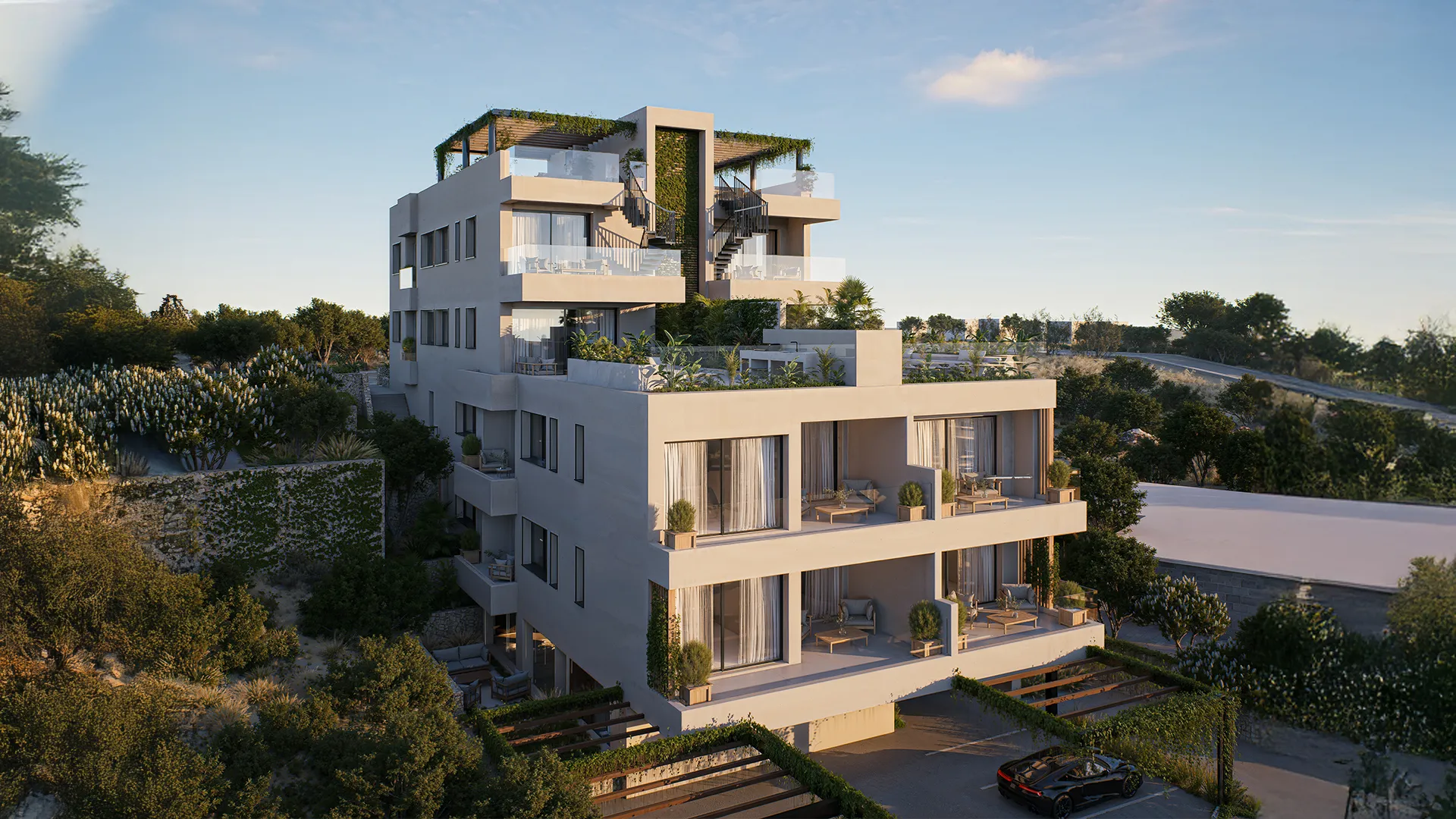
Cyprus records earthquakes every year, and almost none of them damage a modern building. The magnitude 5.3 earthquake near Paphos on 12 November 2025 caused no deaths and no injuries, and no building suffered structural failure. The properties cleared that day were cleared as a precaution, not because anything had given way.
That pattern has less to do with luck than with when a building was designed. Earthquake-resistant design has been a legal requirement on the island since 1994, mandatory site supervision followed in 1998, and since 2012 every new building has been designed to Eurocode 8, the European standard for seismic resistance.
Which is why, for anyone looking at a property in Paphos, the seismic question is answerable rather than abstract. This guide covers where Cyprus sits geologically, what the November 2025 earthquake actually involved, how the island’s record reads across seven decades, and what the rules require today. It ends with the documents worth asking for before you commit to a specific address.
What Happened: The Recent Earthquake in Paphos
The earthquake that put Paphos in the news on 12 November 2025 was not one event but a sequence. A magnitude 5.2 shock was recorded late that morning, a 4.7 followed ten minutes later, and the largest of the day, magnitude 5.3, arrived in the afternoon. Some agencies logged both main shocks at 5.3. All were shallow crustal events, with epicentres inland, north-east and east of the city near the village of Polemi.
What stood out was the pace rather than the size. Aftershocks followed within minutes of each main shock and continued into the next day, several dozen in total, each smaller than the event that produced it. A dense aftershock sequence is the ordinary way stored energy is released, and it is the loading pattern a building designed to Eurocode 8 is engineered to absorb. The Geological Survey Department, which runs the island’s seismic network and collects felt reports from residents, tracked the sequence throughout.
Shaking was reported from 47 locations across five countries, as far as northern Israel and Lebanon, and public buildings across Cyprus were cleared for the afternoon as a precaution. Local authorities reported minor damage, including a rockfall on the Paphos to Tsada road, and no major structural damage anywhere. A satellite-based assessment published through the UN-SPIDER programme concluded that large-scale destruction was unlikely.
The gap between how widely the sequence was felt and how little it broke is the part worth understanding. The explanation is not geology. It is what those buildings were required to withstand before anyone moved into them.
Is Paphos at Real Seismic Risk?
Cyprus sits near a plate boundary, so the honest answer is that the island records earthquakes and always will. That is not the useful question for a buyer. The useful question is how large they get, how often they arrive, and what a given building was designed to absorb. All three have answers, and none of them is guesswork.
What causes earthquakes in Cyprus?
Cyprus lies just north of the Cyprus Arc, the boundary along which the African plate moves northward against the Eurasian plate. The United States Geological Survey puts that convergence across the Mediterranean at 4 to 10 millimetres a year.
Scale matters more than the mechanism. The same USGS summary places the highest rates of Mediterranean seismicity along the Hellenic subduction zone off southern Greece, the North Anatolian Fault in western Turkey, and the Calabrian zone off southern Italy. Cyprus lies on the same broad plate boundary without sitting at its most active point.
Most of what the movement produces is never noticed. The USGS catalogue lists around two dozen earthquakes of magnitude 5 or above in the Cyprus region over the past thirty years. Most were offshore, and a large share of them belong to a single aftershock sequence in 1996. Events strong enough to be felt indoors are a normal part of the year; events that damage a modern building are not part of the record at all.
Which parts of Cyprus feel earthquakes most?
Activity is not spread evenly. The record concentrates it along the southern and western coasts, the parts of the island closest to the plate boundary, while the Troodos interior and the Nicosia plain register less. The Paphos and Limassol districts both sit inside that coastal band.
This is accounted for rather than ignored. The National Annex to Eurocode 8 divides Cyprus into seismic zones and assigns each zone its own reference ground acceleration, the figure an engineer designs against. A building in the coastal band is designed for a higher demand than an equivalent building inland. The requirement follows the hazard, which is why a new apartment in Paphos is engineered to a stricter brief than its address alone would suggest.
Earthquake Timeline: Notable Events in Cyprus
Cyprus has a well documented seismic record, catalogued by the Geological Survey Department back to the start of the instrumental era. Read on its own, a list of magnitudes says very little. Read alongside the building rules in force at the time, and the depth of each event, it says almost everything.
| Date | Magnitude | Where | Building rules then | What followed |
|---|---|---|---|---|
| 10 Sep 1953 | Ms 6.5 | Paphos district | No seismic code existed | Around 500 buildings were lost and more than 10,000 damaged across 158 settlements, almost all traditional stone and mud brick |
| 24 Feb 1995 | Mw 5.9 | 40 km NW of Paphos | Code in force one year; standing stock predated it | Around 50 homes lost and 70 seriously damaged, concentrated in older masonry construction |
| 9 Oct 1996 | Mw 6.8 | 37 km SW of Paphos, 80 km deep | Code two years old | The strongest event in the island’s instrumental record. No modern structure failed |
| 15 Apr 2015 | M 5.3 | 6 km west of Kissonerga, near Paphos | Eurocode 8 mandatory since 2012 | Felt across the district. No damage reported |
| 11 Jan 2022 | Mw 6.6 | 48 km WNW of Polis | Eurocode 8 mandatory since 2012 | Felt nationwide. Minor damage in the Paphos and Nicosia districts, none structural in newer buildings |
| 12 Nov 2025 | M 5.2 to 5.3 | Inland, near Polemi | Full Eurocode 8 regime | Minor damage only, no casualties, precautionary evacuations |
Two patterns run through that table, and neither is about luck.
The first is depth. The 1996 earthquake was by a clear margin the largest Cyprus has recorded, and it did comparatively little, because 80 kilometres of rock stood between the rupture and the surface. Magnitude alone is a poor predictor of what a building actually experiences.
The second is the age of the buildings. In every entry above, what suffered was construction that predated the rules, not construction built under them. That pattern has held for seven decades, and it is the one that transfers directly to a purchase decision, because it is the one thing a buyer can still check.
Is There a Tsunami Risk in Cyprus?
Tsunami is the question that follows almost every felt earthquake on an island, and Cyprus does have a record of it, though a very thin one. The National Oceanic and Atmospheric Administration notes that most tsunamis are generated by earthquakes above magnitude 7.0 occurring under or very near the sea floor. Cyprus reached that threshold once in recorded history, in 1222, when a large offshore earthquake sent a wave into Paphos harbour. Nothing comparable has occurred in the eight centuries since.
Smaller earthquakes can produce small local waves without doing damage, as one did off Paphos in 1953. Cyprus’s instrumental record contains no destructive tsunami at all. The island is nonetheless treated as a place that plans for the possibility, which is a reassuring detail rather than a worrying one: Cyprus is a member state of the UNESCO-IOC tsunami warning system for the North-Eastern Atlantic and Mediterranean, with Civil Defence acting as the national warning focal point, and the Geological Survey Department publishes inundation maps for the coastline.
Building Standards in Cyprus: What Buyers Should Know
Cyprus did not arrive at its present rules in a single step, and the dates matter more than the label. Earthquake-resistant design became a legal requirement in 1994. Mandatory supervision of construction on site followed in 1998. Since 2012, new buildings have been designed to Eurocode 8, the European standard written so that in an earthquake human lives are protected, damage is limited, and buildings needed for civil protection stay operational.
The 2012 step is the one most often misread. It did not introduce seismic design to Cyprus. It replaced a national code with a European one and tied the design load explicitly to location, through a National Annex that assigns each seismic zone its own reference ground acceleration. Buildings put up between 1994 and 2011 were designed to a seismic code as well. That distinction is worth stating plainly, because a large share of the Paphos housing stock sits in exactly that window.
| Before 1994 | 1994 to 2011 | From 2012 | |
|---|---|---|---|
| Earthquake-resistant design | Not required | Required, national seismic code | Required, Eurocode 8 (CYS EN 1998-1) |
| Supervision during construction | Not required | Mandatory from 1998 | Mandatory |
| How the design load is set | Not defined | National seismic code | National Annex, reference ground acceleration by seismic zone |
For a buyer, the current rules come down to a short list that should be true of any compliant new build in Paphos:
- the structure is engineered against a calculated seismic load rather than sized by convention
- foundations are matched to the ground conditions of the specific site
- materials and methods are certified, and the work is inspected at defined stages
- the design and the completed building are signed off by licensed engineers
None of that is exotic or optional, which is precisely the point. It also means the useful question about a property in Paphos is rarely whether Cyprus has adequate rules. It is which side of these dates the building sits on, and whether the documentation exists to prove it. A development being completed now, Luma’s projects among them, sits in the right-hand column of that table by default. An apartment resold from 2005 sits in the middle one, and a village house from the 1960s in the first. All three are legal to buy. They are not the same purchase.
What Seismic Safety Does and Doesn’t Tell You
Seismic standing answers one question about a property and no others. It says nothing about price, about which part of Paphos suits a particular buyer, or about rental demand. What makes this the question worth settling first is that it is fixed the moment the building is designed and cannot be changed afterwards without substantial cost. Every other number attached to a property can still move.
What to Ask Before Buying a Property in Paphos
Everything above is general. This is the part that applies to one specific address, and most of it can be settled with documents rather than opinions. None of these questions is unusual, and a vendor who finds them awkward has told you something useful.
- When was it built, and under which rules? The dividing lines are 1994, 1998 and 2012. A completion date places the building in one of the three columns above, and almost everything else follows from that.
- For a completed building, is there a Certificate of Final Approval? The CFA confirms that the finished building matches the permits it was approved under. It is issued through the Building Committee on the certification of the civil engineer, and the District Lands Office will not issue title deeds without it. For a finished property being resold, its absence is the clearest signal to slow down.
- For a property still under construction, what exists instead? A CFA cannot be issued before a building is complete, so on an off-plan purchase the equivalent evidence is the planning and building permits, the structural design, the geotechnical report for the site, and the supervision records generated so far. Ask to see those, and ask what the schedule is for the CFA.
- Do supervision records exist from the construction period? Site supervision has been mandatory since 1998. For anything completed after that date, the records exist, or there is a reason why they do not.
- Was a geotechnical investigation carried out before the foundations were designed? Seismic performance depends as much on the ground as on the frame. The question is whether the soil at that specific plot was assessed, and what the foundation design was a response to.
- What foundation system was used, and who signed the structure off? Design and completion should both carry the sign-off of a licensed engineer. Certified materials and inspection at defined stages belong to the same paper trail.
- For an older property, is an independent survey worth commissioning? For anything predating 1994 it usually is, and many buyers commission one for pre-2012 resales as well. Surveys are carried out by engineers registered with ETEK, the statutory chamber for the profession, and are commonly quoted from around 500 euro depending on the size and complexity of the property. Set against the other costs of buying in Cyprus, that is a small line.
Luma makes this documentation available to buyers on request, at whatever stage a project has reached. That is not a statement about intent. It is the paperwork the process generates anyway, and any developer building to current rules should be able to put it on the table.
FAQ: Frequently Asked Questions
Do earthquakes in Cyprus cause serious damage to buildings?
Rarely, and almost never to buildings designed under the current rules. In the island’s recorded events, damage has concentrated in older stone and masonry construction predating the 1994 seismic code rather than in engineered modern structures.
Is Paphos in a high-risk earthquake zone?
Not in the sense the phrase usually implies. Western Cyprus records more felt tremors than the interior, and the National Annex to Eurocode 8 assigns the coastal band a correspondingly higher design demand. Cyprus as a whole sits well below the seismicity rates of the Hellenic subduction zone off southern Greece or the North Anatolian Fault in Turkey.
Should I be concerned about buying property near a fault line?
The building matters more than the distance. Cyprus’s significant faults lie largely offshore to the south and west, and design requirements already account for location through the seismic zone a site falls in. A compliant building close to the coast is engineered for a higher load than an equivalent one inland.
What makes a home earthquake-resistant?
A reinforced concrete frame engineered against a calculated seismic load, foundations matched to the ground conditions of the specific plot, certified materials, connections designed to absorb movement, and inspection at defined stages of construction. Since 2012 all of this has been governed in Cyprus by Eurocode 8.
How strong can earthquakes in Cyprus get?
The strongest in the island’s instrumental record was magnitude 6.8, on 9 October 1996, roughly 37 kilometres south-west of Paphos and about 80 kilometres deep. Claims of magnitude 9 events in Cyprus are not supported by any record.
Is there a tsunami risk in Cyprus?
Low. Most tsunamis are generated by earthquakes above magnitude 7.0 occurring under or very near the sea floor. Cyprus has reached that threshold once in recorded history, in 1222, and its instrumental record contains no destructive tsunami. The island takes part in the UNESCO-IOC tsunami warning system for the Mediterranean, and inundation maps for the coastline are published by the Geological Survey Department.
Do Luma Developers properties meet seismic safety standards?
Yes. Luma’s developments are designed under Eurocode 8 and its Cyprus National Annex, with geotechnical assessment of each site and licensed engineer sign-off. The supervision and approval documentation is available to buyers on request at each stage of a project.
Why Trust Matters More Than Magnitude
The largest earthquake Cyprus has ever measured did comparatively little, and a smaller one seventy years earlier did a great deal, because the buildings standing at the time, and the rules behind them, were not the same. Magnitude is the number that makes the headline. It is rarely the number that decides the outcome.
That puts the decision back within reach. A buyer cannot influence the plate boundary, the depth of a rupture or the timing of the next event. A buyer can establish, before signing anything, when a building was designed, which code it was designed under, who supervised the work, and whether the documents exist to show it. Those four answers do more work than any reassurance a developer can offer, including this one.
Luma builds to the current rules and keeps the paperwork that proves it. That is the whole claim, and it is the kind that can be checked.